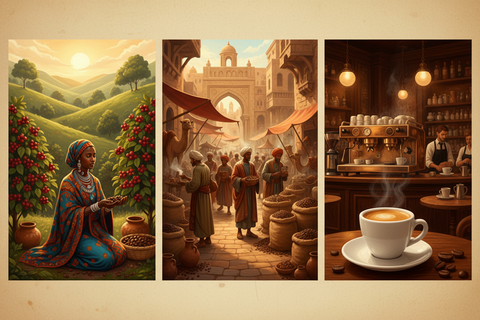
Decaffeinated coffee has won the trust of those who love the ritual of a cup but don't want to give up their sleep or don't tolerate caffeine well. Yet many clichés still circulate around decaf: that it's "dirty water", that it has no flavour or that it's full of chemicals. In this guide we set the record straight with verifiable information: what caffeine-free coffee is, how much is really left, how it's made and when it's worth choosing.
What decaffeinated coffee is and how much caffeine is left
Decaffeinated coffee is perfectly ordinary green coffee from which most of the caffeine has been removed before roasting. It is therefore neither a different variety nor a substitute: it's the same Arabica or Robusta bean, treated to reduce its caffeine content.
How much is left? European and Italian regulations set a precise threshold: in decaffeinated coffee the residual caffeine must be below 0.1% of the product. In practice, a cup of decaf generally contains only a few milligrams of caffeine, compared with the tens of milligrams of a traditional espresso. It's the difference between a trace and an active dose.
How coffee is decaffeinated: the main methods
Decaffeination is always carried out on the green bean, because it is before roasting that the caffeine can be extracted without compromising the aromas. There are three families of methods, all regulated and safe when they comply with the legal limits.
Water method (Swiss Water)
It is the most "natural" method, because it uses no chemical solvents. The green beans are immersed in water together with a green coffee extract (Green Coffee Extract): the caffeine migrates from the bean into the solution and is then captured by passing the liquid through activated carbon filters. The Swiss Water process can remove up to about 99.9% of the caffeine while leaving the aromas largely intact.
Carbon dioxide method (CO2)
Developed in the scientific field, it uses CO2 in a supercritical state (around 31 °C and at high pressure) as a selective solvent. The CO2 binds to the caffeine and draws it out of the beans, then is removed without leaving chemical residues. It is a method very respectful of the aromatic profile, often used for large volumes of quality coffee.
Solvent methods (European method)
The beans are treated with a solvent, typically ethyl acetate (of natural origin, also present in fruit) or dichloromethane, which captures the caffeine. The beans are then repeatedly steamed and washed to remove the residual solvent. Regulatory bodies consider the residues permitted in the finished product to be safe, but it is the method that arouses the most curiosity and attention among consumers.
- Water / Swiss Water: solvent-free, clean profile.
- Supercritical CO2: selective, no chemical residue.
- Solvents (ethyl acetate or dichloromethane): effective and economical, regulated by law.
Myths about decaf to debunk
The most widespread prejudice is that decaf is "flavourless". In reality, when you start from a good green coffee and use respectful methods such as water or CO2, decaf retains body, sweetness and aromatic notes. The difference from a quality coffee with caffeine can be minimal on the palate.
- "It's full of chemicals": the water and CO2 methods use no solvents, and in the solvent methods the residues are within the legal limits.
- "It tastes of nothing": the flavour depends on the quality of the bean and on the roasting, not on the absence of caffeine.
- "It's completely caffeine-free": it's not "at zero", but below 0.1%, a minimal amount.
- "It's bad for you": it's simply coffee with less caffeine, suitable for wider consumption throughout the day.
When to choose caffeine-free coffee
Decaffeinated coffee is the ideal choice in several situations:
- In the evening and after dinner: to enjoy the ritual of coffee without compromising your sleep.
- During pregnancy and breastfeeding: when you want to reduce caffeine intake, always following your doctor's advice.
- For those sensitive to caffeine: anyone who experiences a racing heartbeat, nervousness or digestive discomfort can continue to enjoy coffee with a much lighter impact.
- For those who drink many coffees a day: alternating with decaf makes it possible not to exceed the recommended amounts of caffeine.
Available formats
Decaf doesn't mean giving up your habits: today it is available in practically all formats, so it can adapt to every machine and every moment of the day.
- Ground coffee for moka pot and espresso machine.
- Coffee beans for those who grind on the spot.
- Decaffeinated capsules and pods for maximum convenience.
Conclusion
Decaffeinated coffee is not a compromise, but a smart way to enjoy coffee: the same pleasure, the same aroma, much less caffeine. Thanks to methods such as water, CO2 and controlled solvents, today it is possible to drink a quality decaf at any time of the day.
Want to try the difference? Discover our selection of caffeine-free coffees in the decaffeinated collection by Caffè Sistemi and find the perfect format for your moka pot, your espresso machine or your capsules.