Behind every little cup lies a journey spanning centuries and continents. Coffee travelled from the mountains of East Africa to the courts of the East, from the ports of Venice to the bars across Italy, until it became that daily ritual we take for granted today. Here is its story, told in brief.
The origins: the legend of Kaldi
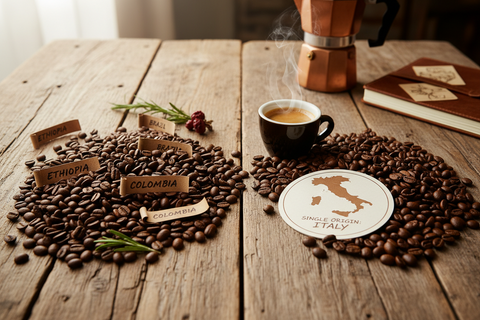
The coffee plant (Coffea) is native to the highlands of Ethiopia. The most famous legend tells of Kaldi, a goatherd who noticed his goats becoming strangely lively after grazing on certain red berries. Intrigued, the monks of a nearby monastery tried those berries and found they kept them awake during their long nightly prayers. Legend or not, it is certain that coffee has very ancient roots in this region.
The Arab world: the drink is born
It was in Yemen, around the 15th century, that coffee began to be cultivated and roasted as we understand it today. In the Sufi monasteries its stimulating effect was prized during rituals. Soon the first coffee houses (qahveh khaneh) appeared in the cities of the Arab world, from Mecca to Cairo to Istanbul: places of meeting, music and conversation. The port of Mokha, in Yemen, became so important that it gave its name to the "moka".
The arrival in Europe and in Venice
Through trade with the East, coffee landed in Europe in the 17th century, and Venice was one of the first gateways. At first it was viewed with suspicion, so much so that some called it "the devil's drink"; according to tradition, however, Pope Clement VIII tasted it and "baptised" it, approving its consumption. Thus the first coffee houses were born: in 1720 the famous Caffè Florian opened in St Mark's Square, still in business today. Literary cafés became cultural salons all over Europe.
The invention of espresso
The Italian turning point comes between the late 19th and early 20th centuries. The idea was to use pressure to extract a faster and more concentrated coffee. In 1884 Angelo Moriondo patented a first steam machine in Turin; a few years later Luigi Bezzera and Desiderio Pavoni perfected it for use in bars. But it is in 1948 that Achille Gaggia introduces the lever machine: thanks to a pressure of about 9 bars, modern espresso is born, with its unmistakable crema. Espresso, ordered "on the go" at the counter, becomes the symbol of Italian speed and sociability.
The moka enters the home
If espresso was a matter for the bar, it was the moka that brought the ritual inside the home. In 1933 Alfonso Bialetti created the famous eight-sided aluminium coffee pot, the Moka Express, which with its Art Deco design and the little moustachioed man became an icon of Italian design around the world. Ever since, the gurgle of the moka has been the soundtrack of Italian mornings.
From roastery to capsules
The 20th century is also the century of the great Italian roasteries, which turned the blend into an art, balancing Arabica and Robusta to achieve body, crema and aroma. In recent decades convenience has brought single-dose systems: first pods, then capsules, which today allow you to have a bar-quality espresso in a few seconds, with the perfect dose and no waste.
In conclusion
From Kaldi's goats to the capsule you pop in every morning, coffee has travelled through history while always remaining what it is: a pleasure to be shared. Knowing its journey makes every cup even more special. In our catalogue you will find the blends of the finest Italian roasteries in pods, capsules and beans: a small piece of this long story, ready for your cup.